
Open offices ask a lot from one space. One person is taking a video call, another team is workshopping an idea, while someone three desks away is trying to concentrate on a proposal that was due yesterday.
The problem is not simply noise. It is acoustic privacy, or how well a workplace limits unwanted speech from travelling clearly between people and work zones. When nearby conversations are easy to understand, they can compete for attention and make focused work harder.
That does not mean productive offices need to be silent. It means collaboration needs boundaries. func. helps create those boundaries with adaptable acoustic screens, dividers and partitions that can support focus without locking the office into one permanent layout.
Key takeaways
Acoustic privacy is different from simply reducing noise.
Understandable speech can be particularly distracting.
Focused tasks generally need greater protection from speech distraction.
Different types of work need different acoustic conditions.
Acoustic privacy can move as the workplace changes.
How Poor Acoustic Privacy Disrupts Focus and Productivity
Every distraction asks an employee to do something twice: focus on the task, lose that focus, then find their way back.
Nearby conversations can be particularly disruptive because speech carries information. When employees can understand what someone else is saying, their attention can be pulled away from the task in front of them. Reading, writing, coding, engineering, analysis and other memory-heavy activities can be especially vulnerable to this kind of distraction.
Better acoustic privacy does not guarantee a neat percentage increase in productivity. People and workplaces are more complicated than that. What it can do is create better conditions for concentration by reducing irrelevant speech competing for employees' attention.
When people spend less effort filtering the room around them, they have more attention available for the work they are actually there to do.


Why Speech Is Harder to Ignore Than General Office Noise
A workplace does not need to be particularly loud to be distracting. Sometimes the more useful question is: how much of the conversation can you understand?
The brain naturally processes meaningful speech. A steady background sound may fade into the working environment, while an understandable conversation keeps delivering new information for the brain to notice. That is why speech intelligibility matters when thinking about workplace focus.
It also highlights an important difference between general sound control and acoustic privacy.
Sound control | Acoustic privacy |
Reduces unwanted or reflected sound | Limits how clearly unwanted speech is understood |
Helps manage the overall acoustic environment | Helps reduce speech distraction between people and zones |
Focuses on controlling sound | Focuses on where understandable speech travels |
A quiet office can still have poor acoustic privacy. Sometimes the biggest distraction is not the loudest sound. It is the conversation you cannot stop understanding.
Different Work Needs Different Levels of Acoustic Privacy
There is no single perfect acoustic environment because there is no single way people work.
Brainstorming and collaboration naturally involve more conversation. Writing a report, reviewing technical drawings or working through a complex engineering problem needs something different. Add video meetings and confidential calls to the mix, and today's hybrid office is asking one floorplate to do several acoustic jobs at once.
Type of work | Acoustic privacy need |
Collaboration and brainstorming | More tolerance for conversation |
Routine individual work | Moderate separation |
Phone and video calls | Separation from nearby focus work |
Writing, coding, engineering and analysis | Greater protection from speech distraction |
Confidential conversations | Higher speech privacy |
This is where zoning matters. func.'s acoustic privacy screens can help create different levels of separation across an open workplace without treating every desk or activity the same way.

What Does Good Acoustic Privacy Look Like in Practice?
Good acoustic design starts with two questions: where is distracting speech coming from, and where do people need to concentrate?
From there, workplace teams can:
Separate focus zones from collaboration and social areas
Create dedicated spaces for phone and video calls
Consider workstation orientation and direct speech paths
Use sound-absorbing materials to manage reflected sound
Use screens and partitions to interrupt speech between zones
Consider sound masking where appropriate
Provide genuine focus spaces instead of making headphones the default privacy strategy
And no, better privacy does not automatically mean building another room.
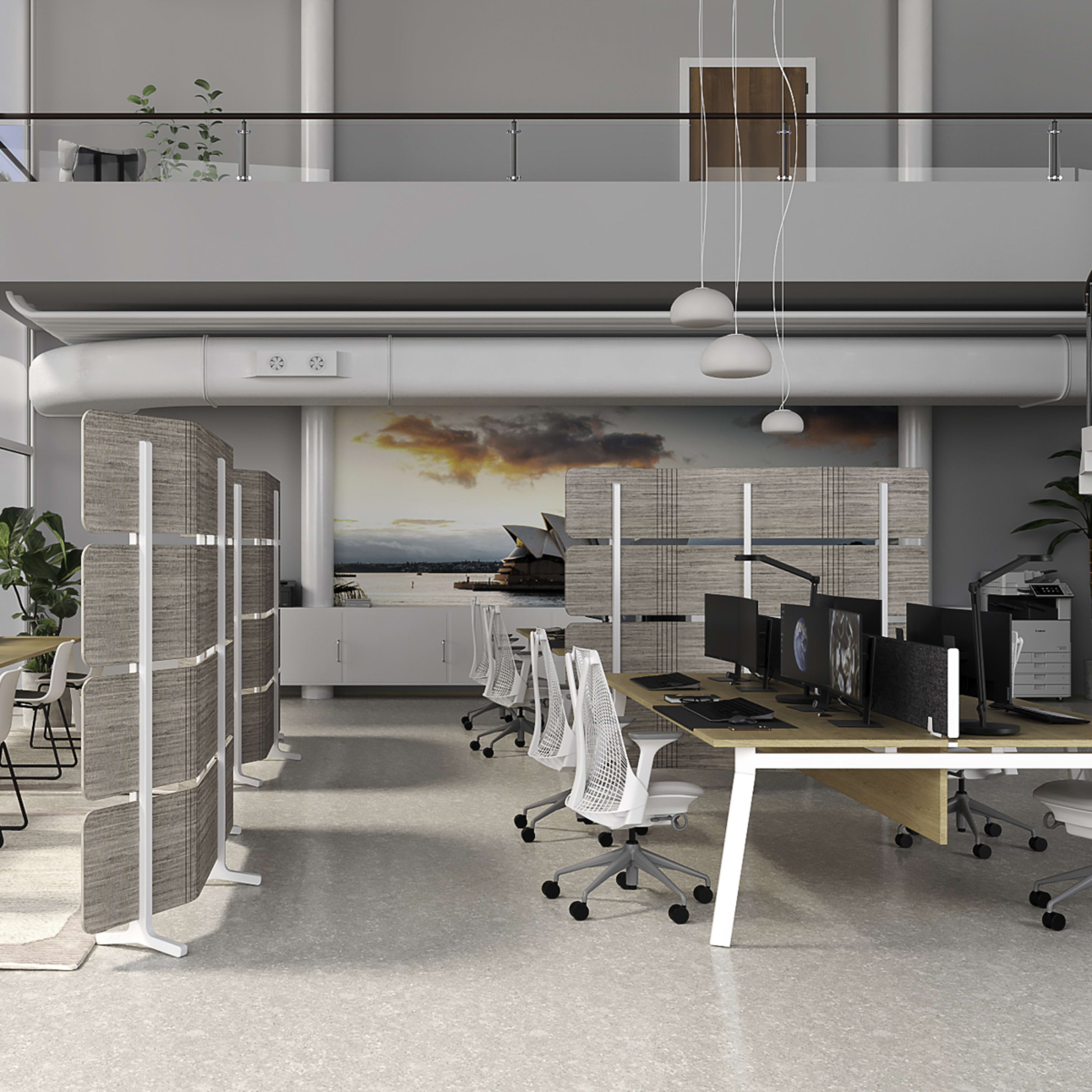
func.'s acoustic workstation dividers and acoustic desk partitions can introduce localized separation around individual and shared desks. Hanging office dividers offer another way to define areas while maintaining a more open visual environment.
For larger zones, freestanding office partitions and a freestanding partition wall can separate focus, meeting and collaboration areas without permanently fixing those boundaries in place.
The point is not to put acoustic products everywhere. Put privacy where the distraction happens.
How Do You Know If an Office Has Enough Acoustic Privacy?
Decibels only tell part of the story.
Speech intelligibility, Speech Transmission Index (STI) and distraction distance provide other ways of understanding how conversations behave within a workplace. Put simply, distraction distance considers how far understandable speech travels before it becomes less intelligible.
You do not need to turn the facilities team into acoustic engineers. The practical question is much simpler:
How far away can someone still clearly follow a conversation that has nothing to do with them?
If employees can understand conversations happening across the floor, the office may have a speech privacy problem even if it does not seem particularly loud.


Why Acoustic Privacy Needs to Move With the Workplace
Today's focus zone could be next year's collaboration area. Teams expand, shrink and relocate. Hybrid attendance changes throughout the week. Video calls appear in places that were never designed around them.
The acoustic plan has to keep up.
Permanent construction can create separation, but changing it can mean more work, cost and disruption. Movable screens and partitions offer another approach: create the privacy the workplace needs now, then reposition it when requirements change.
func.'s freestanding partitions, screens and workstation dividers are designed around that flexibility. Instead of demolishing and rebuilding every time the floorplan evolves, businesses can redefine focus and collaboration zones while keeping their acoustic solutions in use.
That matters beyond acoustics. A solution that can work through multiple layouts can deliver more long-term value than one designed around a single version of the office.
Create a Workplace Where Focus and Collaboration Can Coexist
Acoustic privacy isn’t about limiting open offices, collaboration or conversation. It’s about creating the right conditions for each to happen comfortably and effectively.
When reviewing a workplace, ask whether employees can focus when they need to, how far conversations travel, whether different tasks have appropriate privacy and whether those spaces can adapt as the business changes.
func. helps workplace teams create adaptable acoustic separation at different scales, from desk-level dividers to screens and movable partitions. The result is not a silent office. It is an office where collaboration can stay collaborative and focused work has room to happen.